
Regina's Housing Strategy

The City of Regina is updating its Housing Strategy. The Strategy will guide the City in supporting a sufficient supply of housing, of all types, preserving and renewing existing housing and assisting residents to be housed. The Strategy and its actions will be data and community-driven, with input from the housing sector, including developers, builders, operators such as for-profit and non-profit organizations, designers, realtors and financers.
This Be Heard page is the City's way of communicating with the public about the process. Suggestions are encouraged and can be made by emailing CHS@regina.ca.
-
History of Regina’s Housing Strategy
The City’s current Comprehensive Housing Strategy was approved in 2013. It informed changes to the City’s housing policies, such as:
- Focusing the Housing Incentives Policy on affordable housing and adding tax exemptions for secondary and backyard suites.
- New policies in Design Regina: The Official Community Plan that increase the minimum number of people per hectare for new neighbourhoods.
- Expanding permissions for suites in existing homes, backyards and garages to encourage development.
- Establishing building code advisories to support emerging housing types such as basement, backyard and garage suites.
- Revising zoning regulations to streamline requirements under The Regina Zoning Bylaw, 2019.
- Establishing staff positions focused on housing which increased the City’s capacity to participate with the housing industry and to advocate for and collaborate on housing issues.
The City fully or partially completed 64 of 86 unique action items in the 2013 Comprehensive Housing Strategy, an implementation rate of 74 per cent. These actions supported housing development despite economic shocks in Saskatchewan in 2013/2014, 2019 and the COVID-19 pandemic from 2020 to 2022 (median housing starts for 2013 to 2024 were 1,140 compared to 1,105 from 2003 to 2012). This supply helped keep housing prices and rents stable from 2013 to 2021.
Regina’s Current and Future Housing Needs
Housing conditions have changed since the Comprehensive Housing Strategy was adopted in 2013, and a new strategy is needed. In 2024, the City undertook a Housing Needs Assessment, which reviewed statistical data and engaged members of the community to identify current housing challenges and forecast the amount and type of housing needed for future growth. Some of the key findings in 2024 were:
- Regina needs to nearly double the number of housing starts between 2021 and 2051 to keep up with projected growth.
- Available housing options need to be expanded to include:
- Single-family homes;
- Townhouses, small apartments, secondary and backyard suites;
- Apartment buildings;
- Homes for large and multi-generational families;
- Homes for single people;
- Accessible homes for people with physical and sensory disabilities, including the elderly; and
- Affordable housing.
- Significant infrastructure investment is needed to support housing development, particularly in water, wastewater and drainage.
The latest State of Homelessness report has also identified that homelessness in Regina has increased drastically. In the 2024 Point-in-Time Count, 824 people were identified as homeless in Regina. This was a 69 per cent increase from 2021 and a 255 per cent increase compared to 2015. Some key findings:
- 75 per cent of the people interviewed identified as Indigenous despite Indigenous people only making up 10 per cent of the general population.
- 47 per cent of those interviewed reported intergenerational trauma and 10 per cent were impacted by residential school experiences.
- 54 per cent said they experienced mental health issues and 71 per cent reported substance use challenges.
- 36 per cent indicated that they have mobility challenges.
- 31 per cent reported sensory impairment.
- Only 37 per cent accessed doctors’ services and 17 per cent received mental health care.
- 25 per cent said that they first experienced homelessness as a minor and 28 per cent of those interviewed were living with children (37 per cent of which were under age five).
- Homelessness among seniors and newcomers is an emerging issue.
A new Housing Strategy is needed in response to continuing growth in Regina’s population and the emerging issues listed above. The Strategy will consider housing across the entire continuum.
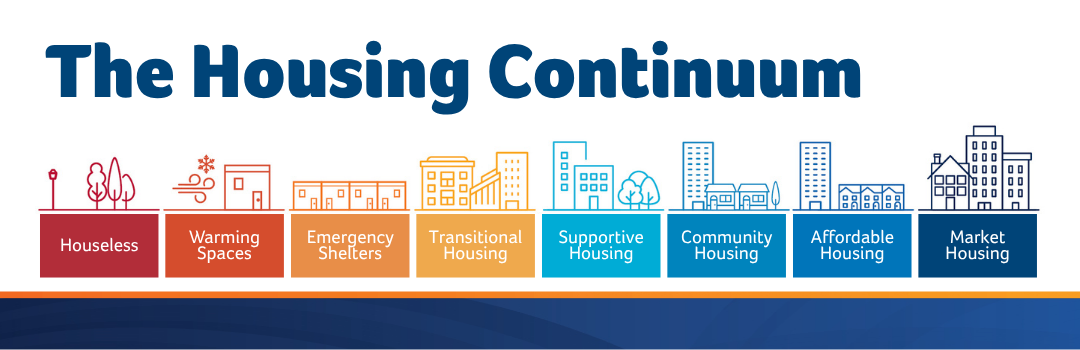
This requires ensuring that regulations support the housing market in providing a sufficient supply of homes and options for housing, as well as making investments in areas of the housing continuum that the market does not effectively address. This includes shelters, transitional and supportive housing, affordable housing, accessible housing for those with physical and sensory disabilities, and specialty housing such as multi-generational homes.
The City is one player in this complex ecosystem. The Housing Strategy will identify the City’s role relative to the private sector, the non-profit sector and the provincial and federal governments.
-

Email CHS@regina.ca

